Von Akaba nach Damaskus – ein Ritt durch die syrische Wüste. Eine Sendung von Eckehard Piestrick.
02. Februar 2009, 18 Uhr auf Radio Corax.
> [mehr]
> [Podcast]
Comments Off on TINYA Podcast #33: Ein Ritt durch die syrische Wüste
Von Akaba nach Damaskus – ein Ritt durch die syrische Wüste. Eine Sendung von Eckehard Piestrick.
02. Februar 2009, 18 Uhr auf Radio Corax.
> [mehr]
> [Podcast]
Through all times Sinti and Roma have been famous for their musical talent and their fascinating, colourful music culture.
Sources from medieval Germany convey, that they have been esteemed as musical instrument makers and musicians on the court of king Sigismund in the 15. century. But the scources convey as well, that already by then Sinti and Roma had to be protected from assaults by a decree.
Throughout the centuries the music of the Sinti and Roma has developed a great number of different styles, which have their rootes in uncountable places of the world. The restless wandering of the Roma peoples began in the northwest of India, leades them till Turkey and to Egypt, through the countries of the Balkan until Central Europe and further to France till Spain.
The movie Latcho Drom (Save journey) illustrates the homelessness of Sinti and Roma in a haunting and honest way. Music and dance, that accomany those folks in their journey, are playing a central role in this movie. Almost occasionally people explore and absorb new musical elements on their way.
Capturing scenes in the movie form the music of the manganiyar singer Talab Khan, the romanian group Taraf de Haidouks, the song “Auschwitz” recorded in slovakia sung by Margita Makulova who has survived the holocaust and gypsy jazz guitarists Dorado and Tchavolo Schmitt.
One of the highlights is the closing scene performed by La Caíta (Maria del Carmen Salazar). The lyrics of this moving furious song “Pájaro negro” (Blackbird) say “You, You’re a stork who has landed on Earth. Me, I’m a black bird who has taken flight”. [see]
The movie Latcho Drom is the second production of Tony Gatlif in a trilogy on the Roma people. It was preceded by „Les Princes“ (1983) and followed by „Gadjo dilo“ (1997).
In which library can I find the book I´m looking for? The answer usually can be found quickly by using the digital library catalog OPAC. But when I ask, in which archive can I find recordings of maori music from New Zealand, I even don´t have a database to search for. But only until recently …
Supported by the European Commission the DISMARC project has opened up the way towards a digital music archive catalog, uniting more than 40 european institutions and music archives within archives of radio stations, museums and universities.
DISMARC.org:
 |
| Von Rezensionen |
Let´s set an example: I´m looking for music from tanzania.
First I open the site dismarc.org. Here I will find two templates, that offer me two different designs calles „DISMARC“ and „Archive“. This option I actually found a bit confusing, I understand it as a suggestion for the user, that can choose between the two designs. The search result will be the same.
I go on working with the template „Archives“ held in a office-design.
On the table I find a phonograph leading to a playlist. With a bell I can open a site that provides information about the project. A click on the globe forwards me to the map of the world – the music delta. The table itself has drawers. Here I can select between 20 languages, in which the archive is running. In the filing cabinet to the left I can type in my searching details.
Typing in only the word „tanzania“ the archive reveals it´s huge content and wide approach, offering a big variety of musical styles connected with the word „tanzania“.
Next I add the option „Items with Audio Samples“, that filters the entries including audio samples. The archive reveals, that the EMEM (Ethnomusicology, Media-Technology and Berlin Phonogramm-Archiv) has fieldrecordings from tanzania.
One of the recordings I find helpfull, so I put it in my basket. This step allowes me to send an email to the EMEM to express my interest in this recording. Now I could obtain a copy of the recording provided by the archive at a cost.
MUSICDELTA.com
 |
| Von Rezensionen |
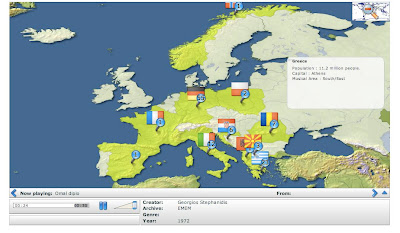
On a digital world map you can explore ethnographic recordings of music from many parts of the world. The examples have a duration of 30 seconds and are provided by the Berlin Phonogramm-Archive.
The DISMARC project is to be considered as still in process. The support of the „e-content plus“ programme of the european commission has ended. What is necesary now is further financial support and a fixed team of archivists and musicologists to take care of the database and to let it grow. A position for public relations would be of great importance as well.
> DISMARC
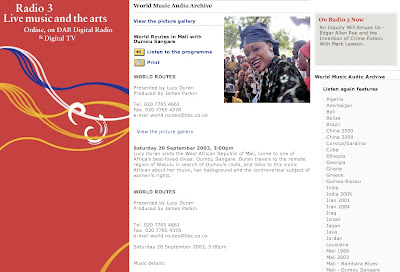
All of you who enjoy listening to radio features and documentations should visit the homepage of BBC 3 World Routes. There can be found a tremendous selection of so called “On-Location” Features, that explore music from around the world. They can be listened to in full length with the real-player.
 |
| Von Rezensionen |
Ethnomusicologist Lucy Duran and the british broadcaster Andy Kershaw have travelled through many countries on different continents. They report straight from the locations, describing situations, people, places and first of all music.
Some journeys are accompanied by the producer James Parkin, that captures fantastic fieldrecordings, spontaneos singing and music playing of the people.
The documentations presented by Lucy Duran furthermore have an academic ethnomusicologist approach. Against the background of the problem, that academics do usually not place any importance on radio as a serious medium for academic research, she has written an essay about the topic. Lucy Duran is lecturer in African music, an undergraduate tutor and an undergraduate admissions tutor in the Department of Music School of Oriental and African Studies at the University of London.
> Lucy Duran: ESSAY: “Radio as research: fresh perspectives on Oumou Sangare’s music”
19. – 26. März 2009 (Germany, Netherlands, Czech Republic)
The concert tour “hidden voices” borrowes its name from Eckehard Pistrick´s fictional travel diary to the Epirus mountains. It brings together Albanian Diaspora Singer Elina Duni and Band, the multipart group “Jonianet” from Saranda, Arjan Shumbulli’s Saze Ensemble and the Albanian poet Gerda Dalipaj in a unique concert tour through Germany, Netherlands and the Czech Republic.
 |
| Von Albanische Musik |
Traditional Albanian Music remains even in the age of Multimedia based on oral tradition, transmission and improvisation. In the broken verses of young poet Gerda Dalipaj the boundaries between ethnology, poetry and music become blurred. Comparable to medieval troubadours the singers of the South Albanian multipart group “Jonianet” recall the old times, emotions and their longings.
Critically acclaimed Ethno-Jazz singer Elina Duni searches for the essence of these folk melodies complimented by new Jazz-coloured perspectives. The traditional clarinet ensemble Saze, reminder of the Ottoman heritage, finally adds to these diverse perspectives on Albanian Music the dynamics of a captivating instrumental wedding music.
Welcome to a tightrope walk between past and future of Albanian Music, a fascinating musical microcosm which was declared an Intangible World Heritage by UNESCO in 2005! (EP)
T O U R :
19. März 2009, 19:30 Uhr, Kulturforum FÜRTH, Germany
20. März 2009, 20:30 Uhr, RASA Cultural Center, UTRECHT, Netherlands
21. März 2009, 19:00 Uhr, Schloss GOSECK, Germany (Albanian Dinner)
25. März 2009, Lecture on Albanian Music and Concert, University OLOMOUC, Czech Republic
26. März 2009, Kostel Sv. Simona a Judy, Prague, Czech Republic
Festival coordination: Eckehard Pistrick
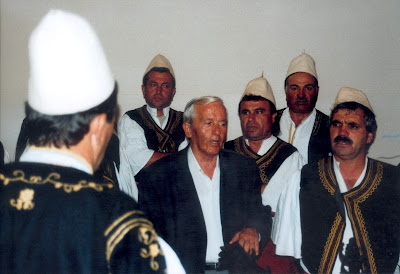
Foto: Rhapsode Kico Kapedani mit seinen Sängern aus Saranda und Delvina, Eckehard Pistrick.
03 Jan, 2009
Posted by: Redaktion In: Website-Reviews
Tropicália [tropicalia.uol.com.br]
Through this marvellous website you can explore in a most pleasant way an indeed short (1967/68), but quite lively period in the history of brazilian popular music called tropicália.
 |
| Von Rezensionen |
The website provides a huge archive of articles, interviews, statements and music related wirh the protagonists of tropicalism like Caetano Veloso, Gilberto Gil, Gal Costa, Tom Zé, the rock band the Mutantes and Rogério Duprat.
There are so many deep informations to discover, that here only a few representative aspects can be mentioned. The site contextualizes the tropicalism movement within brazilian history, gives a lively discription of the main happenings, contains a brilliant punctuated chronology comparing the historical happenings with the stages of tropicalism, shows the critical situation between musicians and audience. Further more tropicalia.uol.com.br is designed tastefully colourful and clearly structured.
Certainly you can find videos, fotos, audio material, lyrics, discography and bibliography. The site is ment to be a interactive space, where new information, new scientific articles or multimedia material can be posted constantly via comments.
Tropicalia is a project of the brazilian journalist and productor Ana de Oliveira.
17 Dec, 2008
Posted by: Redaktion In: Reviews
“There´s no one can resist dancing to this music”:
MBUDI MBUDI NA MHANGA. The Musical Universe of the Wagogo Children from Tanzania (2004)
More information about the book: [see here]
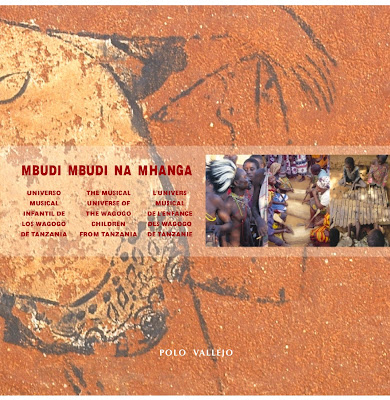
A true gem of a book is the publication “Mbudi Mbudi Na Mhanga. The Musical Universe of the Wagogo Children from Tanzania” of the spanish etnomusicologist, educator and composer Polo Vallejo. Once holding it in your hands I promise, that you will fall in love with it. Although it seems a quite simple word to discribe this complex strucured and tasteful designed book, it is at all just beautiful.
Even more captivating is the polyphonic singing and the wealth of the musical tradition of the wagogo covering songs of amusement, instrumental xylophone-pieces, music of initiation rites and fable-songs.
 |
| Von Rezensionen |
There are varios aspects, why it is a pleasure to read Polo Vallejos approximation to the music of the children of the east-african state tanzania. First of all, when you open the book and turn some pages, it will welcome you with great pictures of the african savannah, as well as portrait-photos showing wagogo people within their lifes. The pages are designed in warm colours. There are drawings of african animals made by the wagogo children and artistic graphics integrated.
“Mbudi Mbudi Na Mhanga”, which means “The Bat and the Orycteropus”, is actually the name of a children’s tale of the Wagogo. Written in three languages (spanish, english and french) the phrases are clearly devised and therefor can be easily understood also by young readers or rather can be read to someone.
There are three main chapters, that examine (1) the wagogo habitants and their culture, (2) the world of children´s music and (3) the musical system. Chapters (2) and (3) though of an etnomusicological background, allow every reader to understand the different musical aspects of the wagogo music. Each chapter is divided in well proportionated articles, where the most important facts on subjects are concentrated like social organization, religious beliefs and rites, life´s stages, repertory, musical training, instruments and musical structures.
Further the articles are punctuated by ten episodes out of the field logbook of Polo Vallejo. One entry tells about the excitement when introducing a multi-track recorder, that isolates one voice. This recording technic permits the individual study of the complex rhythmical patterns. A fourth chapter of the book (4) contains more than 60 valuable transcriptions of children songs and games, girls, boys and collective songs.
The book not only discovers the music of the wagogo, but also intents to raise an understanding of what wagogo life is about. Acompained by two CD´s with more than 60 different songs recorded during fieldworks between 1995 and 2001 and further 40 tracks with pulse demonstrations the book permits a look inside the musical cosmos of a fascinating african musical tradition. Like the Sangura, the rabbit, in the tale “Mbudi Mbudi Na Mhanga” says: “There´s no one can resist dancing to this music”.
Further pulications:
2008: [Patrimonio Musical Wagogo (Tanzania): contexto y sistemática]
Sonntag, 04. Januar 2009 auf Radio Corax.
Eine Sendung von Juliane Kowollik. [mehr]
Erstausstrahlung April 2007.
Die TINYA-Sendung “Chorallenchoräle – Eine Fiesta unter Wasser” von Conrad Dorer wurde mit dem CORAX-Medienpreis 2008 in der Kategorie “Ausgezeichnete Themenpräsentation” ausgezeichnet.
Die Sendung kann ab sofort [
Audio clip: Adobe Flash Player (version 9 or above) is required to play this audio clip. Download the latest version here. You also need to have JavaScript enabled in your browser.
] nachgehört werden.
 |
| Von Studienreise Philippinen |
“Chorallenchoräle – Eine Fiesta unter Wasser”
Eine Sendung von Conrad Dorer. Gesendet auf Radio Corax, Dezember 2007.
Tinya erreicht auf einer Piroge den pazierfischigen Seesternhimmel, rutscht eine Schlammlawine hinab und taucht als Langnasenbüschelbarsch verkleidet zu den Kostümfestivals unter Wasser. In rotem Gewand und mit rosa Püscheln geziert eröffnet die Spanische Tänzerin, eine Nacktschnecke, zu den Rondallaklängen der Brokkoli- und Straußenfederkorallen den Reigen, erzählt die Meeresschildkröte von verschiedenen Kolonialriffzeiten, spricht der Kardinalfisch das Morgengebet, vollführt der Minderheiten-Geisterpfeifenfisch rituelle Tänze … Doch die See wird stürmischer denn je. Die Kofferfische ziehen davon, die Soldatenfische schwirren aufgeregt umher und der Gong der Dynamitfischer dringt näher und näher.
Die International Association for the Study of Popular Music (IASPM) läd vom 13. bis 17. Juli 2009 nach Liverpool ein. Auf dem Kongress sollen die vielfältigen Wechselbeziehungen zwischen “populären Musikwelten” und deren Geschichtsbild reflektiert und diskutiert werden. [Kongress-Webseite]
Es wird Panels zu folgenden Themengebieten geben:
1) Studying Popular Music: A Reassessment
Leitung: Martha Tupinambá de Ulhôa / Rio de Janeiro /
Professorin für Musikwissenschaft am Villa Lobos Institute und im Postgraduierten Programm an der Univesity of Rio de Janeiro (UNIRIO) // Erste Schriftführerin der ANPPOM (National Association of Research and Post-Graduation in Music) // Vizepräsidentin von IASPM-LA (Latin American Association of popular Music) // Forschungsschwerpunkt: Popular Musik Brasiliens.
Since the first attempts in the late 1970s and 1980s much has been done in terms of adapting analytical tools from several disciplines to the study of popular music. This stream welcomes papers dealing with the analysis of specific aspects of popular music (timbre, texture, prosody, melody, rhythm, harmony, arranging, etc.) or case studies of particular songs or instrumental pieces from any theoretical perspective.
2) Popular Music and Technology in a Historical Context
Leitung: Carlo Nardi / Berlin /
Dj, Musikproduzent, Gitarrist, Promoviert im Fach Musikwissenschaft an der Universität Trento und der Humbold-Uni Berlin // Exekutivausschussmitglieder der IASPM.
Different intellectual technologies have contributed to the way people produce and listen to popular music, be it orality, printing, recording or even the Internet. This stream welcomes papers dealing with the technological impacts upon popular music practices, including questions from cultural, aesthetic, ideological, economic, sociological, historical, legal or musicological perspectives.
3) Music, History and Cultural Memory
Leitung: Shane Homan / Caulfield, Australia /
Dozent für Communication and Performance Studies an der Monash University in Caulfield, Forschungsschwerpunkte: Popular music industries, Cultural industries and media policy, Youth and popular music.
This stream seeks contributions that investigate popular music histories and the methodological challenges in their researching and writing. What particular historical narratives and agendas emerge, and what are their effects? The stream includes work that examines the role of popular music history in wider national histories and their presence in both informal (e.g. fan club newsletters) and formal (e.g. museums) contexts. Papers are also welcome that explore the role of ‘unofficial’ / ‘shadow’ music histories that challenge or offer alternatives to grander narratives and industry mythologies, to comprehend a politics of cultural memory studies in terms of what is officially preserved from oblivion and what is socially excluded from remembrance.
4) Music, Mediation and Place
Leitung: Geoff Stahl / Wellington, Neuseeland /
Doktor der Kommunikationswissenschaft.
The intersection of place-making and music-making as a site of mediation is a complicated one. From the use of certain music scenes or moments which have been mobilized as heritage myths and tourist packages, to issues related to the use of micro and mass media to bind musicmakers together–locally, regionally, nationally, and globally–the intersection of time and place as a highly mediated process has proven a vexed and complex phenomenon. We welcome papers which explore the many issues relating to music histories, representations, discourses, spaces and places, as well as those that consider the various research methods which might be best be deployed to capture this phenomenon.
5) Musical Struggles
Leitung: Michael Drewett / Grahamstown, Südafrika /
Dozent der Soziologie an der Rhodes University, South Africa.
Being a musician inevitably involves struggle: Musicians starting out struggle to make it, musicians ‘in the margins’ struggle towards mainstream coverage, some musicians involve themselves in political struggle to do with identity issues and/or social issues, while in contexts of censorship, repression and control some musicians struggle to be heard. Even commercially successful musicians can become embroiled in corporate struggle over contractual obligations. This stream seeks contributions which document and conceptualise such struggles within a socio-political framework.